
How to Practice Piano as an Adult Beginner
Learning to play the piano as an adult can be an exciting and rewarding journey.
Many adults come to the piano with a clear goal: perhaps you want to finally learn a piece you've always loved, play for your family, accompany yourself while singing, or simply enjoy making music after a long day of work.
But one question comes up again and again:
“How should I practice?”
The answer isn't simply to practice more. What matters most is learning how to use your practice time well.
As an adult, your practice time may be limited. You may have work, family, and many other responsibilities competing for your attention. That's why having a clear and effective approach to practice can make a tremendous difference.
Here are some habits I recommend developing from the beginning.
Essential Practice Tips for Adult Piano Students
1. Give Yourself a Goal
Before you sit down at the piano, know what you want to accomplish.
Your goal doesn't have to be big. In fact, smaller goals are often much more useful.
Instead of thinking:
“I need to learn this whole piece.”
Try:
“I want to learn the first four measures.”
Or:
“I want to practice the left-hand chords for ten minutes.”
Or:
“I want to play this section three times without stopping.”
A specific goal gives your practice direction. It also gives you something you can actually accomplish in one session.
When you finish, you can look back and say, “I did that.”
Those small accomplishments add up over time.
If you're working on a new piece, learning how to divide it into manageable sections can make the process much easier. You can read more about this in my post, “How to Break Down a Piece of Music into Smaller Chunks for Practice.”
2. Start by Preparing Your Hands and Mind
Before immediately jumping into the most difficult part of your piece, give yourself a few minutes to settle into the instrument.
You might play a few scales, simple exercises, or patterns that help you become familiar with the keyboard and wake up your fingers.
But warming up isn't only about the fingers.
It is also a way to transition mentally into your practice time.
Take a moment to sit comfortably. Check your posture. Relax your shoulders and arms. Notice the feeling of your fingertips on the keys.
For me, good technique begins with natural movement and relaxation. A warm-up is a good opportunity to become aware of how your body feels before you start asking it to do more demanding work.
3. Quality Matters More Than Quantity
It is easy to think that practicing for two hours must be better than practicing for thirty minutes.
Not necessarily.
Thirty minutes of focused, thoughtful practice can be much more productive than two hours of simply playing through the same mistakes.
When you practice, slow down enough to notice what you're actually doing.
Are the notes accurate?
Is the rhythm steady?
Are your hands relaxed?
Are you following the fingering?
Are you hearing the melody clearly?
Are you following the dynamics and articulation?
If something isn't working, stop and figure out why.
Don't simply repeat the same passage again and again and hope it improves.
Practice should be active.
You are not just moving your fingers—you are listening, observing, thinking, and making adjustments.
4. Use a Metronome and Record Yourself
Two simple tools can make your practice much more objective: a metronome and your phone.
A metronome helps you develop a reliable sense of pulse and rhythm. When learning a new passage, start at a tempo where you can play accurately and comfortably. Then gradually increase the speed as your coordination becomes more secure.
Don't use the metronome simply to make yourself play faster. Use it to learn what a steady beat actually feels like.
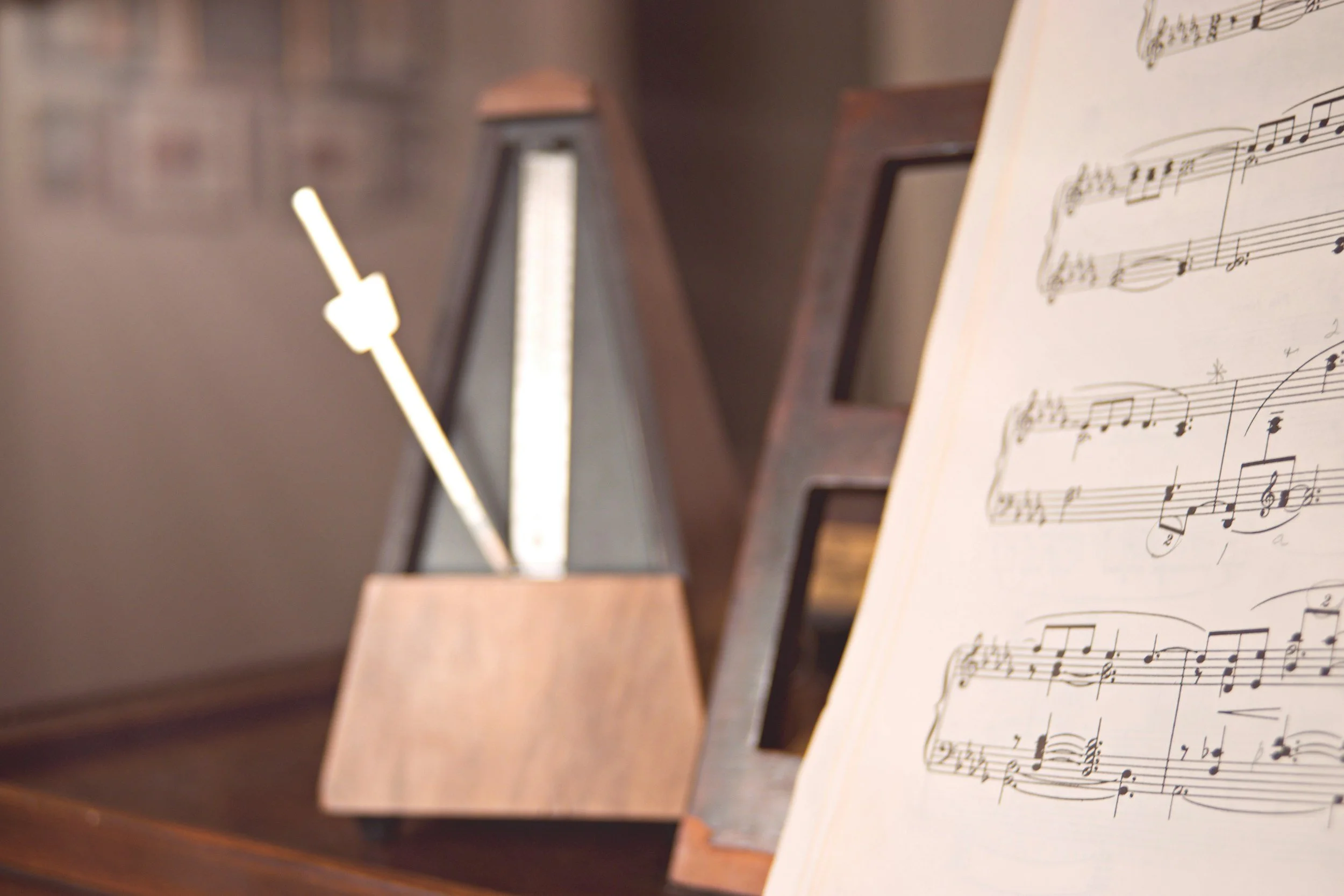
Practice with the metronome
Recording yourself is another incredibly useful practice tool. (Read my post How to Record Yourself While Practicing Piano — And Why You Should)
When you're playing, you are focused on many things at once. It can be difficult to hear your own playing objectively.
But when you listen to a recording afterward, you may notice things you didn't notice while playing: an uneven rhythm, a rushed passage, unnecessary tension, or a melody that isn't coming through clearly.
Watching yourself can also help you observe your posture and movement.
Recording yourself regularly can become a valuable part of learning how to become your own teacher.
For more ideas, read my post, “How to Record Yourself to Help You Practice.”
5. Practice in Small Chunks
One of the biggest mistakes beginners make is repeatedly playing a piece from beginning to end.
It feels productive because you're playing the whole piece, but it doesn't necessarily mean you're improving the parts that need the most attention.
Instead, break the music into smaller sections.
Work on a phrase, a few measures, or a particularly difficult passage.
Practice that section slowly and carefully. Once it feels comfortable, connect it to the section before or after it.
This approach allows you to focus on the details without feeling overwhelmed by the entire piece.
It also helps you recognize exactly where a problem is occurring.
If you keep making a mistake in one measure, don't restart the entire piece every time. Stop and work on that measure.
Your practice time should be spent where it is most needed.
For a more detailed approach, read my post, " How to Break a Piano Piece into Smaller Sections "
6. Don't Forget to Make Music
Practice doesn't always have to feel like work.
As important as technique, rhythm, and accuracy are, the reason we learn piano is ultimately to make music.
Give yourself time to play something you enjoy.
Maybe it's a favorite song you've known for years. Maybe it's an easier piece you've already learned. Maybe you want to experiment with a melody or improvise a little.
Listen to different kinds of music, too. Explore Baroque, Classical, Romantic, Impressionist, and contemporary music. The more you listen, the more your ears become familiar with different sounds, styles, and ways of expressing music.
This is especially important for adult students. You don't have to rush toward some distant idea of becoming a “perfect pianist.”
Enjoy the process of learning.
7. Celebrate Your Progress
Progress on the piano can sometimes be difficult to notice because you're always aware of what you still cannot do.
A piece that felt impossible three weeks ago may now feel much easier—but because you're already thinking about the next challenge, you might not notice how far you've come.
That's why I encourage students to record themselves playing an entire piece from time to time.
Don't worry about making it perfect.
Just record it.
Keep the recording as a little snapshot of where you are at that moment.
You can even share it with family or friends if you'd like. More importantly, keep some of these recordings for yourself.
Months or years later, you can listen back and hear your own progress.
Sometimes there is no better motivation than realizing, “I couldn't play this before, and now I can.”
Practice Is a Journey
Learning piano as an adult is not a race.
There will be days when everything seems to come easily, and there will be days when even a simple passage feels frustrating.
That's normal.
What matters is developing a practice routine that allows you to make steady progress without losing the joy of playing.
Set a small goal.
Prepare your hands and body.
Practice slowly and thoughtfully.
Listen to yourself.
Work in small sections.
Pay attention to the details.
And most importantly, remember to enjoy the music.
You don't need hours of practice every day to become a better pianist. You need consistency, patience, and a willingness to pay attention to how you practice.
Little by little, those focused moments at the piano become something much bigger: greater confidence, stronger technique, better musical understanding, and the freedom to express yourself through music.